Head Coach, ASD Life Coaches
If you’re an autistic adult, you’ve probably felt it: the sense that your friendships aren’t “real” unless they turn into something deep. You meet someone in a class or at work, you click, and then months later you’re still at small talk and it feels like a failure. Like you’re doing friendship wrong.
You’re not. Most friendships are supposed to stay right where they are.
That’s the idea behind THE NEURODIVERGENT RELATIONSHIP PYRAMID™, a coaching framework we use with clients at ASD Life Coaches™ to make sense of how friendships actually grow and why most of them were never meant to become best-friendships in the first place.
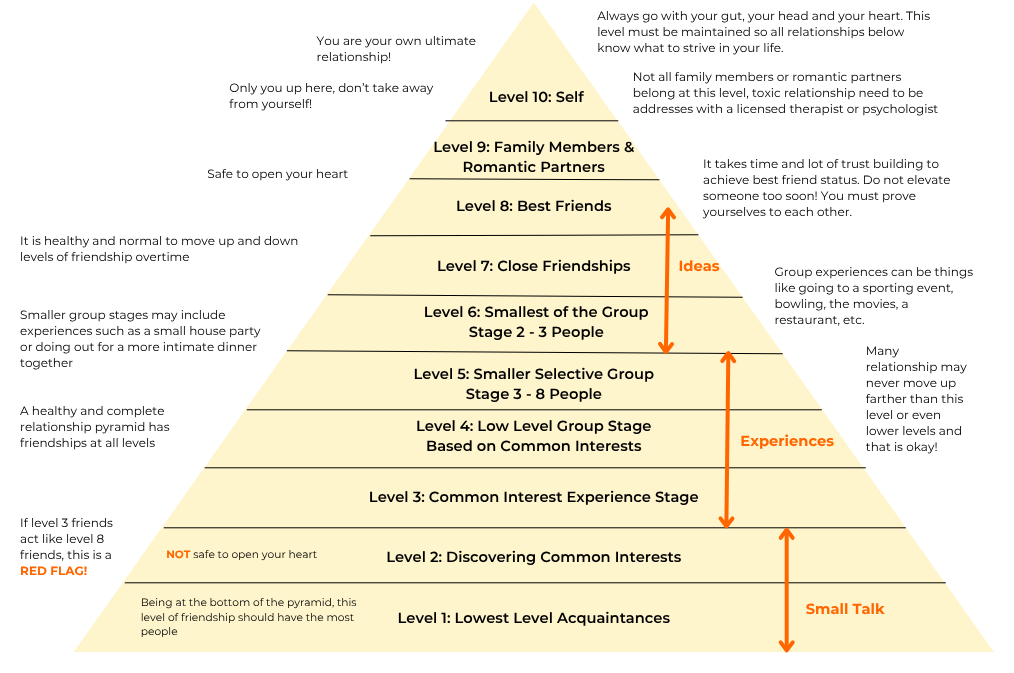
Friendship Is a Pyramid, Not a Ladder
Picture a pyramid with ten levels, wide at the bottom and narrow at the top. The bottom holds the most people: neighbors, coworkers, people you’ve met once or twice. Small talk only, and that’s completely appropriate and no vulnerability is expected there, and none should be offered.
As you move up, relationships change shape rather than just “getting better.” You start discovering shared interests, then actually doing things together, such as a class, a hobby group, a project. Somewhere in the middle, a regular group forms: the same people at the same gathering, week after week. For a lot of people, that’s where things settle permanently. And that’s not a plateau to escape, it’s one of the healthiest, most common places for a relationship to live.
Only a small number of people ever move further, into a selective group, then a tight handful of close friends, and eventually, for maybe one or two people in your life, best friends. At the very top sits something that surprises a lot of clients: yourself. Your relationship with yourself is the level every other level is quietly measured against.
Why This Reframe Matters for Neurodivergent Adults
A lot of us grew up being told, directly or indirectly, that we’re “bad at friendship.” That belief usually comes from measuring every relationship against the top of the pyramid, best friend or nothing, instead of recognizing that a full, healthy social life is supposed to have people at every level. A healthy pyramid isn’t all top. It’s mostly base.
That reframe alone tends to relieve a surprising amount of shame in coaching sessions. Having twenty acquaintances and four group friends isn’t a smaller version of having one best friend. It’s what a complete social world actually looks like.
The Red Flag Worth Knowing
The pyramid also gives language for something that’s hard to name in the moment: when a new acquaintance starts acting like a decade-long friend. Oversharing early, demanding closeness, assuming intimacy before any trust has been built, that’s a Level 3 person behaving like a Level 8 person, and it’s a pattern worth noticing rather than ignoring out of politeness or hope. Genuine closeness is built through repeated, consistent experience. It can’t be declared into existence by either person.
Movement Goes Both Ways
One more piece clients find freeing: it’s normal for a friendship to move down the pyramid, not just up. Life changes such as someone moving, having a kid, changing jobs and a close friendship settling back into an occasional-group friendship isn’t a failure. It’s just life. The pyramid isn’t a test you pass once and keep forever; it’s a living picture of where things stand right now.
Our coaches use The Neurodivergent Relationship Pyramid with clients every week. Want to map your own friendships with it?
Schedule Your Free ConsultationHow We Use It in Coaching
In sessions, we don’t just explain the pyramid once and move on. Clients use it as an ongoing reference to place a real relationship on the map, to plan a next step that actually matches the level they’re at, and to catch themselves (or someone else) trying to skip ahead. Over time, it becomes less of a worksheet and more of an instinct: a way of asking “where is this relationship, really?” before deciding how to act on it.
If friendship has always felt like a confusing, high-stakes guessing game, a framework like this can turn it into something much more concrete, and a lot less lonely.
The Neurodivergent Relationship Pyramid™
See all ten levels of the friendship pyramid and how our coaches use it, level by level.
THE NEURODIVERGENT RELATIONSHIP PYRAMID™ is a trademark of ASD Life Coaches™.
About the Author
Jaclyn Hunt, ACAS
Jaclyn Hunt is the pioneer of autism life coaching and Head Coach at ASD Life Coaches. She has been coaching autistic and neurodivergent adults since 2013 and is the author of Life Coaching for Adults on the Autism Spectrum. Read full bio →
Want to work through your own relationships using this framework?
Our coaches help neurodivergent adults build friendships that fit their real lives. Schedule a free consultation with ASD Life Coaches today.
Or meet our coaches and explore our coaching services.
Related Articles
Why Trust Has to Come Before Touch: The Neurodivergent Intimate Relationship Pyramid™
For many neurodivergent adults, relationships go wrong when connection outpaces trust. How The Neurodivergent Intimate Relationship Pyramid helps you pace romance.
Transitioning From Parent to Supportive Consultant: A Guide for Families of Autistic Adults
A guide for families of autistic adults on shifting from manager to supportive consultant, honoring autonomy while stayi
Parent Burnout in Autism Families: Recognizing the Signs and Finding Your Way Back
Recognize the signs of parent burnout in autism families and find practical, compassionate ways to recover, refill your